
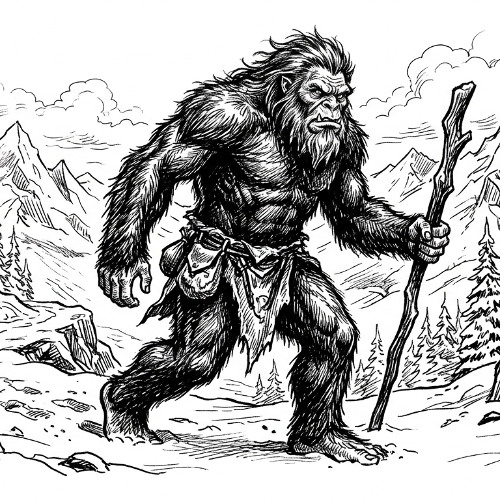
Short stories of adventure, based on real events and myths from around the globe. The emerald labrynth: A botanist in the forests of 1930's India is lost, and stalked by a Leopard. Yeti Tibeti: A groups of explorers and mountaineers run into trouble on Mount Everest, and are helped by a mysterious creature.
The Emerald Labyrinth: An Account of Peril and Providence in the Western Ghats I
I. The Labyrinth Entered
The emerald canopy of the Western Ghats is, to the untravelled eye, a masterpiece of sublime light and shifting shadow; yet to the unfortunate soul ensnared within its depths, it reveals itself as a green sepulchre lined with emerald teeth. In the vast and untamed dependencies of the Indian Empire, narratives of those swallowed by the primeval jungle are a frequent and sobering currency—vividly recounted by the tea-planters of Munnar and the intrepid surveyors of the Nilgiri Hills who have had the misfortune to stray from the beaten path.
My own harrowing chronicle commences in a manner painfully familiar to the annals of geographical exploration: a misplaced stride, a treacherous shortcut that proved a snare, and the sudden, suffocating realization that the jungle had closed its ancient gates behind me. I had been engaged in a solitary botanical excursion along the rugged fringes of the Periyar tract.
My design was a modest one—a four-hour circuit that should have returned my person to the base encampment before the evening tiffin. However, a sudden and violent monsoon squall transformed the dry nullahs into raging torrents of liquid mud, and the faint track I deemed familiar was utterly expunged by a deluge of debris and fractured bamboo. By the hour the heavens ceased their fury, the sun was but a dying ember dipping behind the jagged peaks, and the Great Asian Jungle began to exhale its humid, predatory breath.
The first axiom of wilderness survival, as prescribed by our finest frontiersmen, dictates that one must remain stationary; yet the primal instinct of preservation screams for elevation. Discovering a jagged outcrop of granite rising like a fortress wall from a sea of impenetrable lantana scrub, I scrambled upward with frantic haste. It was upon reaching this precarious sanctuary that I first experienced that singular, icy prickle upon the nape of the neck which betrays the presence of an unseen observer. It was not the Lord of the Jungle—not yet. It was that more insidious entity: the "Ghost of the Forest.
II. The Siege of the Leopard
I discerned the leopard first as a subtle, undulating ripple through the elephant grass. Illuminated by the silver beams of the rising moon, its silhouette was fluid, silent, and entirely devoid of friction. Unlike the royal tiger, whose immense weight often announces its approach by the crackle of dry timber, the leopard advanced like a column of evening smoke. I pulled my limbs close to my chest, pressing my spine against the unforgiving stone, while clutching a heavy bough of ironwood I had fortunately scavenged. The beast did not utter a traditional roar; rather, it emitted a sound resembling the rasp of a coarse saw cutting through rough timber—a rhythmic, guttural cough that vibrated with terrifying resonance within my very ribs.
+-------------------------------------------------------------+ |
AN EXTRACT FROM MY FIELD JOURNAL | | | | "The brute circles the base of my redoubt with a tireless, | | clockwork precision. Its eyes, burning with a pale, sulphur | | luminescence, lock upon mine with every rotation. It is a | | siege not of physical violence, but of pure, unadulterated | | nervous exhaustion."
| +-------------------------------------------------------------+
By the dawning of the second night, hunger had subsided into a dull, hollow ache, but thirst had become a screaming demon in my throat. In a desperate bid for water, I had descended from my citadel and driven deeper into the valley, praying to strike a tributary of the Great Periyar River. My garments were reduced to tattered rags by the wait-a-bit thorns, and my flesh had become a gruesome map of leech-bites and festering ulcerations. It was during the twilight hour that the atmospheric equilibrium shifted. The cicadas, whose deafening cacophony usually filled the forest air, ceased their clamour with an abruptness that was deafening.
The leopard, which had been shadowing my flank from the upper ridgeline, vanished into the shadows like a phantom. In the Indian wild, such absolute silence is never a token of peace; it is the herald of a monarch. Then, the heavy, musky stench of raw flesh and dried grass assailed my nostrils.
III. The Advent of the Sovereign
The tiger did not employ the stealthy tactics of its lesser cousin. It simply manifested. He was an animal of magnificent, terrifying proportions—a streak of orange and black fire that appeared far too large for the tangled undergrowth it inhabited. The beast halted some fifty yards distant, its massive tail twitching with a slow, hypnotic rhythm. It did not regard me with the feline curiosity of the leopard; it gazed upon me with the cold, aristocratic indifference of an apex predator assessing a casual morsel of protein. "There is a majesty in the countenance of Panthera tigris that unnerves the civilized mind. It looks upon Man not as its master, but as its rightful property."
I retreated step by step, my heart hammering a frantic, erratic tattoo against my ribs. “Do not break into a run,” I whispered, recalling the counsel of seasoned shikaris. “To run is to declare oneself a deer.” I maintained a steadfast gaze upon its broad, striped visage, backing toward a dense thicket of wild ginger. The tiger emitted a low, sub-audible rumble—a sound that literally vibrated the atmosphere and seemed to extract the very oxygen from my lungs. It advanced a single, deliberate pace, its massive paws falling with absolute silence upon the damp leaf-mould. I was utterly checked. Behind me lay a precipitous, impassable ravine; to my left, the opportunist leopard reappeared, emboldened by the grander predator’s presence, waiting to contest the scraps of my carcass. I stood as the wretched centrepiece of a nightmare—a fragile son of Empire suspended between two of the most efficient killing mechanisms known to natural science.
The tiger crouched. Its ears flattened against its skull. It was the final, terrible heartbeat before the spring.
IV. The Intervention of the Titan
Then, the very foundations of the earth trembled. At first, my faculties suggested a landslip—a phenomenon common to these hills after the monsoonal rains. Yet the tremor possessed a distinct, rhythmic cadence. Thump. Thump. Thump. A profound, infrasonic vibration reverberated through the valley, so deep it resonated in the very marrow of my bones. From the wall of impenetrable bamboo to my right, a colossal grey bastion erupted into the clearing. It was no mere solitary bull, but a venerable matriarch—a true titan of the Ghats. Her ancient tusks were chipped and stained with dark earth, and her ears were tattered like the battle-flags of a regiment long in the field. Behind her, the remainder of her matriarchal herd emerged from the gloom—three mature cows and a small, uncoordinated calf.
The tiger, accustomed to unconditional submission from all he surveyed, spat and hissed with a venomous fury. It was an expression of supreme frustration. He was loath to abandon his prize, yet even a five-hundred-pound tiger possesses the sagacity to decline a contest with four tons of enraged maternal instinct. The matriarch did not pause to parley. She charged. She unleashed a trumpet that shattered the evening stillness—a piercing, metallic shriek that caused the waterfowl to explode from the canopy in a panicked cloud. Lowering her massive crown, her trunk coiled tightly for protection, she plowed through the dense lantana as though it were tissue paper.
VI. The Great Matriarch
The tiger vanished in a blur of orange lightning, bounding into the deep recess of the jungle. The leopard, perceiving the instant overthrow of the old hierarchy, had vacated the field before the elephant’s forefeet had even struck the earth where I stood. V. Under the Shield of the Queen My knees, having sustained me through hours of terror, finally gave way, and I collapsed in a heap at the foot of a wild mango tree. I fully anticipated that the pachyderm would continue her career, or perhaps perceive my presence as an intrusion to be stamped out. Instead, the great matriarch checked her momentum. She came to a halt a mere ten feet from my trembling form, her immense chest heaving from the exertion. She extended her trunk toward me, its sensitive, muscular tip sampling the air for my scent. I cast my eyes upward into her countenance.
The orb of her eye was vast, framed by long, dust-laden lashes, and animated by an ancient, inscrutable intelligence. There was no malice in that gaze. For a fleeting moment, the artificial distinctions of the civilized world fell away; we were merely two living creatures sharing a perilous existence in a hostile land. She did not desert me. The herd deployed themselves about the small glade, effectively constructing a living rampart of grey muscle between my person and the terrors that lurked in the outer darkness. They began to pull down the upper branches, the sound of splintering wood and rhythmic, vegetative mastication becoming a strange, comforting lullaby to my exhausted senses. The matriarch remained closest to my flank, her towering form acting as a breakwater against the nocturnal wind. I sank into the first profound, untroubled slumber I had enjoyed in eight-and-forty hours.
VI. Epilogue: The Dawn of Deliverance
I awoke to the welcome sound of human voices and the distant, rhythmic beating of native drums. The herd had departed with the first light of dawn, leaving behind a flattened colosseum of grass and a trail of massive footprints leading toward the river course. I followed that providential highway. It brought me directly to a patrol path utilized by the Government Forest Rangers, where a search party discovered me some three hours later—terribly dehydrated and rambling in a state of mild delirium, but safely preserved. When I recount these events to my colleagues at the Royal Geographical Society, they speak learnedly of "zoological instinct" and the "territorial animosities of the higher fauna." Yet I remain haunted by the memory of that ancient eye. In the dark heart of the Indian wilderness, where the leopard stalks and the tiger reigns supreme, I can testify that there exists a third power—one of unexpected, towering magnanimity. I was not merely saved by a fortuity of nature; I was taken into the protection of a queen.
Yeti Tebeti
The year was 1921. To the sahibs of the British Mount Everest Reconnaissance Expedition, the high, forbidden kingdom of Nepal was a map of blanks, a fortress of ice to be conquered with transit-theodolites, heavy woollen tweeds, and iron-shod boots. But to me, Ang Tsering, the Mahalangur Himal was not a geographical challenge. It was the home of the gods, and the domain of things that lived before man. We had marched from Darjeeling, through the leech-swamps of Sikkim, and ascended into the high, thin air where the earth strips itself bare. The leader of the sahibs, Colonel Howard-Bury, was a man obsessed with lines on paper. The younger climber, Mr. Mallory, looked at the Great White Goddess, Chomolungma, with a burning fever in his eyes. They called the mountain Everest, a hard, flat word that lacked the reverence of the snows. My duties as sirdar were simple: manage the porters, ensure the yaks did not cast their loads into the precipices, and interpret the moods of the mountain. But by the time we pitched our canvas tents at seventeen thousand feet, on the morrow of the Great Glacier, my spirit had grown heavy. The sahibs believed we were alone. They trusted their glass binoculars and their modern rifles.
They did not notice the change in the mountain’s breath. I first knew of the Mitre—the Kangmi, whom the plains-men foolishly call the wild man of the snows—three days into the upper valleys. It was not a footprint, nor a sight. It was a whistle. It was a sound that did not belong to the wind—a sharp, musical swoosh that rose from the dwarf rhododendron thickets far below the ice line, then echoed from the crags above. The other porters heard it and pulled their woollen blankets over their ears, murmuring prayers to the Padmasambhava. They knew, as I knew, that the glacier-spirit was watching. On the fifth day, while tracing a route toward what Mr. Mallory called the North Col, I found the track. The sun had softened the crust of the snow before the afternoon freeze. There, crossing our path at a perpendicular angle, were the impressions of a biped. They were vast—fourteen inches from the heavy heel to the great, splayed toe—but it was not the size that made my blood turn to grey ice. It was the stride. The creature had walked effortlessly up a sixty-degree slope of blue ice where our strongest men had been forced to hack steps with their axes. "Look here, Howard-Bury!" called Mr. Wollaston, the expedition’s naturalist, gesturing toward the tracks with his brass-handled walking stick. "A remarkably large grey wolf, wouldn't you say? Or perhaps a stray langur monkey, loping in the soft snow to form a double impression."
Colonel Howard-Bury adjusted his spectacles and nodded, making a note in his leather-bound journal. "Quite so. The melting of the sun expands the margins of the print. Fascinating phenomenon." I stood behind them, my hands buried deep in my woollen sleeves. I did not correct them. It is forbidden by our elders to speak the true name of the Kangmi aloud when you are within its hunting grounds; to do so invites the creature to grow taller before your eyes until your soul is crushed by its shadow. But I knew it was no wolf. The scent was in the air—the heavy, copper smell of an old predator, mixed with the musky reek of untamed mountain yak. That night, the sky turned the colour of a bruised plum. The wind did not blow; it screamed, descending from the summit of Chomolungma like an army of iron chariots. A blizzard of unparalleled ferocity—the himal storm—trapped our small reconnaissance party on a narrow ridge of shale and shifting ice. The temperature plummeted until the oil in the sahibs' lanterns froze solid. "We must descend to the lower camp!" Mr. Mallory shouted through the roaring white darkness, his face encrusted with frost. His voice was nearly swallowed by the gale. We moved in a desperate, roped line.
The visibility was less than the length of an ice axe. The snow did not fall from above; it drove sideways, sharp as needles, blinding the eyes and stealing the breath. I led the way, feeling for the solid rock beneath the drifts, while the sahibs followed, their heavy boots slipping on the treacherous shale. It was young Mr. Bullock who suffered the calamity. A shelf of wind-driven snow gave way beneath his weight. There was a sharp, cracking sound—the breaking of frozen slate—followed by a muffled cry. The rope snapped taut against my harness, nearly ripping me from my moorings. Through the swirling white sheets, I saw that Mr. Bullock had fallen fifteen feet into a shallow crevasse, his leg twisted beneath him at a grotesque, unnatural angle. "Help!" he cried, his voice faint against the thunder of the storm. "My leg is broken! I cannot move!" Colonel Howard-Bury and Mr. Mallory crawled to the edge, but the wind was too violent.
Every attempt to lower a line resulted in the rope being whipped into the air like a thread. The cold was setting in; within an hour, the frost would claim the injured sahib's fingers, and by midnight, the mountain would have his life. Then, the wind died. It did not fade; it was blocked, as if a great wall had suddenly been erected between our ridge and the fury of the north face. Out of the white curtain of the blizzard, a shape materialized. It did not walk with the shambling gait of a bear, nor the cautious stride of a man. It moved with an immense, terrifying grace, its massive shoulders cutting through the drift as though the snow had no weight. It stood nearly eight feet in height, covered from head to foot in long, silver-grey hair that moved like mountain moss in the wind. Its face was dark, flat, and framed by a high, pointed crown of bone and muscle. The sahibs froze. Mr. Mallory reached for his hunting rifle, but his fingers were too stiff with frost to work the bolt. I fell to my knees, pressing my forehead against the freezing ice. "O Lord of the Glaciers," I whispered in the ancient tongue of the Solukhumbu. "We are small men, foolish men, who have broken the silence of your house. Spare us."
The creature did not look at me. Its eyes—large, amber, and glowing with the cold light of the stars—fixed upon the young sahib in the trench. It emitted a low, vibrating rumble, a sound that silenced the distant roar of the avalanche. With two immense strides, the Kangmi stepped down into the crevasse. Mr. Bullock shrieked as those massive, hair-covered arms reached for him. The creature’s hands were broad, with thick, black nails, yet it lifted the injured explorer with an astonishing, delicate tenderness, cradling him against its massive, musky chest as a mother might carry a child through a crowded bazaar. The creature rose from the chasm. It looked toward the remaining sahibs, its chest heaving with the rhythm of the storm. For a single, eternal second, the ancient world and the modern world looked one another in the face.
Then, without a sound, the Kangmi turned and vanished into the wall of white, carrying the young Englishman into the teeth of the blizzard. "Good God..." Howard-Bury breathed, his hands shaking as he clutched his useless altimeter. "It has taken him." "We must follow!" Mallory cried, his voice returning with a desperate rage. "No, sahib," I said, standing before them and gripping the shaft of my ice axe. "If you follow, the mountain will take you too. The Mitre does not kill when the storm is high. He is the guardian of the high places. Come." I led the remaining explorers through the remainder of that terrible night, navigating by the memory of the stone chortens we had passed days before.
By the grace of the Triple Gem, we found shelter beneath a leeward cliff as the sun rose over the peaks, painting the snows in shades of cold gold and rose. As the storm broke, we searched the upper slopes. We followed no human path, but a single line of giant footprints that led toward a hidden cave in the limestone cliffs above the East Rongbuk Glacier. Inside the cavern, sheltered from the biting frost, we found Mr. Bullock. He was wrapped in his own woollen coat, resting upon a bed of dry mountain moss that must have been gathered before the snows.
His broken leg had been straightened, bound tightly with strips of wild willow bark that no human hand could have found in that frozen waste. Beside him lay a single, perfect crystal of blue glacial ice. He was alive, his breath steady, his skin warm. Of the creature, there was no sign. When we stepped out of the cave and looked toward the upper ridges of Chomolungma, the wind had already begun to sweep the snow clean, erasing the giant tracks as if they had never been written upon the mountain. The sahibs returned to England the following year, where they spoke to the Royal Geographical Society of geographical coordinates, of barometric pressures, and of a "wild man" whose tracks they had photographed at twenty-one thousand feet.
They published books with fine bindings and maps with red lines. But I remained in the valleys of Nepal. And every time the north wind rises from the heights of the Great Goddess, and the sharp whistle echoes through the rhododendrons, I turn my face to the snows and bow to the king who needs no map.
Red Mud
The heavy, red mud of the Nigerian interior was a far cry from the flat, cobbled towpaths of my native Bruges. In August, the West African rains are relentless, transforming the landscape into an emerald ocean of elephant grass and dense rainforest. My bicycle—a sturdy, steel-framed Rudge-Whitworth I had affectionately named Le Brave—was caked in laterite clay, its gears groaning under the strain of a thousand miles of African earth. When I left Flanders in the spring of 1931, my professors at the university wept, and my father threatened to disown me.
For a twenty-three-year-old woman to traverse Europe alone on a bicycle was considered a scandal; to cross the Sahara and venture into the heart of British Nigeria was deemed a form of madness. Yet, as I pedalled through the northern territories of Kano and down toward the southern forest belt, I felt a profound sense of liberation. The starched lace and rigid expectations of Belgian society could not follow me here. By the time the afternoon sun began to drown in a bruise-coloured bank of monsoon clouds, my legs were trembling with fatigue. I had been riding since dawn, navigating washed-out tracks and dodging the occasional lumbering lorry.
Just as the first heavy drops of rain began to crater the dust, the forest cleared to reveal a neat settlement—a collection of mud-walled, thatch-roofed compounds nestled beneath a grove of towering oil palms. My arrival was greeted by a chorus of barking dogs and the high-pitched laughter of children who had likely never seen a white person, let alone a woman straddling a two-wheeled iron horse dressed in canvas divided skirts. Within moments, I was surrounded. It was the women of the village who stepped forward to bridge the gap. A tall, stately woman with tribal scarification marks like elegant cat-whiskers on her cheeks approached me. She wore a vibrant indigo-dyed wrapper, her head tied in a magnificent crown of matching cloth. She looked at my sweat-stained face, my mud-splattered shins, and then at Le Brave. A slow, radiant smile broke across her face. "Welcome, sister," she said in a broken, rhythmic English that echoed the coastal trading pidgin. "You come from far?" "From Europe," I panted, wiping the grime from my spectacles. "From Belgium. On this." I gestured to the bicycle. A collective gasp went through the assembly, followed by a torrent of lively discussion in the local tongue.
The matriarch, whose name I soon learned was Ife, took my trembling hand in hers. Her skin was warm, lined with the history of her people. She didn't treat me as a colonial master, nor as a freak of nature; she treated me as a weary traveller in need of the hearth. I was led into the women’s quarter of the compound, a private sanctuary shaded by wide eaves. As the tropical downpour turned the clearing outside into a red river, I was given a basin of cool well water to wash away the dust of the road. That evening, the world shrunk to the radius of a small, dancing fire. I sat on a woven reed mat among a dozen women and their sleeping children.
The air was thick with the rich, comforting aroma of egusi soup—a rich stew of pounded melon seeds, bitterleaf, and smoked fish—accompanied by a steaming mound of pounded yam. I ate with my fingers, imitating my hosts, which provoked much affectionate teasing and laughter. After the bowls were cleared, the true magic of the African night began. The women folk did not read books; they spoke them. Ife sat with her back against a carved wooden pillar, her voice dropping to a low, theatrical whisper that commanded the room. "In the old days," Ife began, her hands cutting through the firelight, "the tortoise was not a slow creature. He was a great runner, but his pride was his undoing..."
+---------------------------------------------------------------+
| A TALE FROM THE HEARTH | | | | "The Tortoise challenged the Birds to a feast in the sky. He | | borrowed their feathers to fly up, but once there, he changed | | his name to 'All of You.' When the hosts served the food to | | 'All of You,' the clever Tortoise ate everything, leaving | | the birds to starve. In their anger, the birds took back | | their feathers, leaving the thief to crash down to earth— | | which is why his shell is shattered into a thousand pieces." |
+---------------------------------------------------------------+
As the hours passed, the stories shifted from the whimsical to the profound. They spoke of the forest spirits, the Mami Wata who lived in the deep creeks, and the ancient leopards that were the repositories of dead chiefs' souls. I listened, spellbound, realizing that these women possessed a fierce, unbreakable wisdom. They managed the farms, nurtured the families, and held the history of their ancestors in their heads. In their company, the young student from Bruges felt entirely safe. Around midnight, Ife escorted me to a small, circular guest hut at the edge of the clearing. The walls were made of thick, sun-dried clay, and the doorway was covered by a heavy, tightly woven mat of split bamboo. My bicycle was leaned securely against the inner wall.
I collapsed onto the elevated mud sleeping platform, exhausted, the rhythm of the rain on the thatch acting as a heavy narcotic. I do not know what hour it was when I awoke, but the rain had stopped. The jungle was alive with an eerie, dripping silence. Every instinct honed by months on the road told me something was wrong. My heart began to hammer against my ribs. Then, I heard it. Scratch. Scratch. Huff. It was a wet, raspy sound, like a heavy bellows drawing air through sandpaper. It was coming from the other side of the bamboo screen, mere inches from where I lay. Through the gaps in the loose weave of the mat, the pale moonlight filtered in, casting a lattice pattern across the dirt floor. Suddenly, a section of the moonlight was blocked out. A massive, silhouetted head pressed against the screen. I saw the distinct, rosetted markings of a large leopard.
The beast was sniffing the air, drawn perhaps by the unfamiliar scent of European soap or the salt of my sweat. The bamboo screen rattled as the predator pushed its weight against it. The flimsy twine holding the barricade in place began to strain. I was entirely defenceless. My pocket knife was buried deep in my pannier bags, and even if I had it, it would be nothing against the claws of the forest king. I froze, unable to even scream, paralyzed by the raw, unadulterated terror of the hunted. The screen gave a sharp crack as one of the wooden ties snapped. The leopard’s heavy paw, tipped with ivory claws, reached into the gap, feeling for purchase. Then, a sudden fury erupted in the dark. A piercing, guttural battle cry shattered the silence of the night. It wasn't the voice of a hunter or a soldier, but the fierce, resonant roar of a woman defending her home.
Through the gap in the doorway, I saw a flash of indigo cloth. It was Ife. She had not run for the men, nor had she cowered in her hut. She stood in the moonlit clearing, barefoot, wielding a heavy, fire-hardened wooden pestle—the same heavy timber she used to pound yam during the day. With the strength of a woman who worked the earth, she brought the massive club down directly onto the leopard’s flank. "The strike was delivered with such tremendous force that the sound resembled the splitting of a great log." The leopard let out a screech of surprised agony, spinning away from my doorway. It snarled, baring its yellow fangs, its tail thrashing like a whip. But Ife did not retreat. She stepped into the clearing, raising the pestle above her head, her face illuminated by the moon, looking every bit like the ancient warrior queens her people sang about. She banged the timber against a metal cooking pot she had brought with her, creating a deafening, unnatural clamour. "Oya! Out!" she screamed, her voice vibrating with an authority that even the jungle sovereign could not ignore.
From the surrounding huts, other women emerged, banged pots, and waved burning brands taken from the dying embers of the hearth. Faced with an army of fire and iron-willed women, the leopard realized its disadvantage. With a final, frustrated growl, it turned and bounded in a single, fluid motion over the compound wall, disappearing back into the black embrace of the rainforest. I crawled out from the hut, my legs shaking so violently I could barely stand. Ife dropped her pestle and rushed to me, throwing her strong arms around my shivering shoulders. "The forest ghost is gone, my sister," she murmured into my hair, her own breath coming in ragged gasps. "You are safe. We are here."
The remaining hours of the night were spent in the central compound, huddled around a revived fire, drinking warm herbal tea. The men of the village had finally emerged with their dane guns, looking sheepish as they realized the danger had already been dealt with by their wives. The next morning, the sun rose bright and golden, burning off the mist that clung to the palm trees. As I prepared Le Brave for the journey ahead toward the Niger River, the women of the village gathered to see me off. They packed my bags with fresh bananas, roasted groundnuts, and a small carved piece of ironwood for protection. Ife held my hand one last time. "You travel alone, white sister," she said, looking at my bicycle. "But you have the heart of a village woman."
As I pedalled away, the mud splashing against my boots, I looked back at the small settlement disappearing into the green expanse of Nigeria. I had come to Africa seeking adventure, seeking to prove that a woman could cross continents on her own strength. But that night, I learned a far greater lesson. I was never truly alone. Across the globe, beneath different skies and speaking different tongues, there exists an unspoken sisterhood of courage—one that can stare down the terrors of the dark with nothing but a wooden pestle and a fearless heart.


0 comments:
Post a Comment
Many thanks for reaching out to me, I shall respond to you as soon as I can!